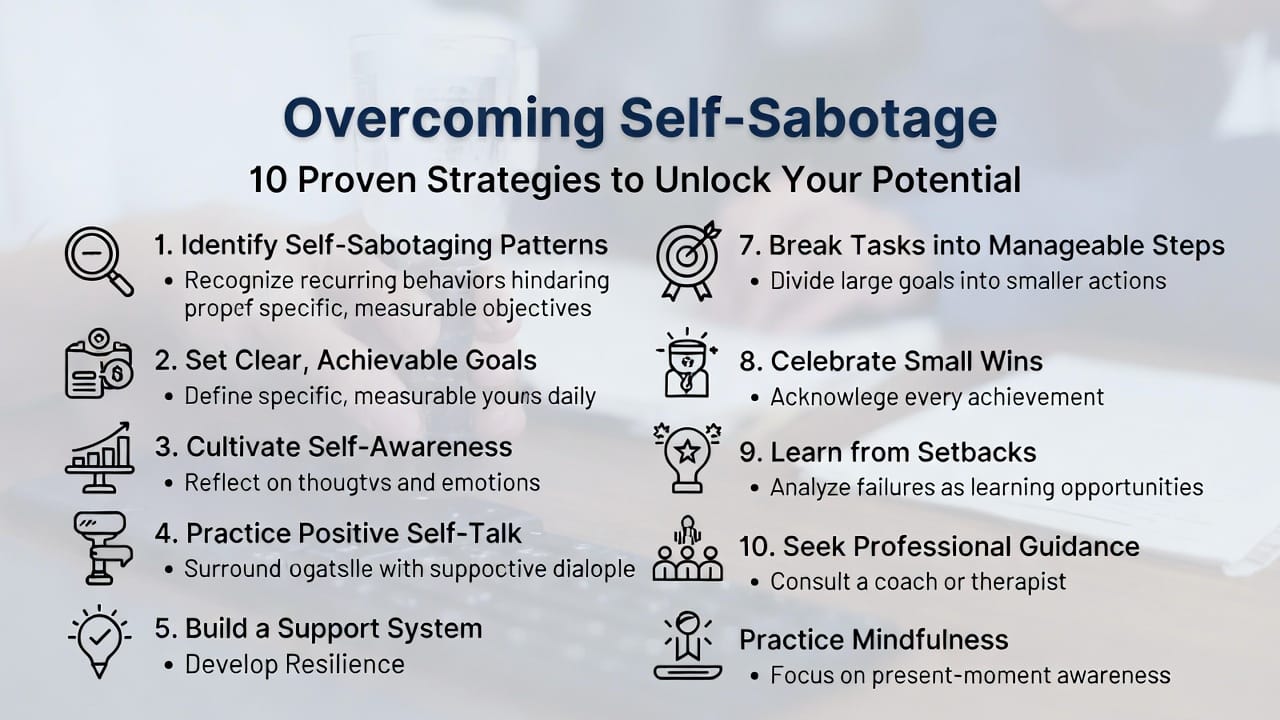
Overcoming Self-Sabotage
Self-sabotage is that sneaky voice in your head that convinces you to undermine your own success. It’s the reason you binge-watch Netflix instead of finishing that important project, or why you pick fights with loved ones right when things are going well. We’ve all experienced it—those moments when we seem hell-bent on derailing our progress despite knowing better. But here’s the good news: self-sabotage isn’t inevitable. It’s a pattern born from fear, past experiences, and unhelpful habits, and with awareness and targeted strategies, you can break free.
In this post, we’ll dive deep into what self-sabotage looks like, why it happens, and most importantly, how to overcome it. Whether you’re struggling with procrastination, perfectionism, or imposter syndrome, these insights and actionable steps will help you reclaim control. By the end, you’ll have a roadmap to build lasting confidence and momentum toward your goals.
Understanding Self-Sabotage: Signs and Symptoms
Self-sabotage often masquerades as laziness or bad luck, but it’s a subconscious strategy to avoid discomfort or perceived threats. Psychologists describe it as behaviors that contradict your long-term goals, driven by short-term emotional relief.
Key Signs You’re Self-Sabotaging
Recognizing the patterns is the first step. Here are common indicators:
- Procrastination on high-stakes tasks: You delay starting a promotion-worthy project, claiming you’re “not ready.”
- Self-isolation: You ghost friends or partners during good times, fearing intimacy or abandonment.
- Substance or distraction reliance: Turning to food, alcohol, or social media to numb anxiety about upcoming opportunities.
- Perfectionism paralysis: Abandoning goals because nothing feels “good enough.”
- Negative self-talk loops: Constantly telling yourself, “I’ll fail anyway,” which becomes a self-fulfilling prophecy.
Consider Sarah, a talented graphic designer. She consistently missed deadlines by scrolling endlessly on her phone, then beat herself up about it. This cycle kept her stuck in a junior role, reinforcing her belief that she wasn’t “cut out” for more.
These behaviors create a vicious cycle: short-term comfort leads to long-term regret, eroding self-trust. Studies from the American Psychological Association show that chronic self-sabotage correlates with higher stress, depression, and stalled career growth. The good news? Awareness disrupts this loop.
Root Causes: Why We Undermine Ourselves
To overcome self-sabotage, we must address its origins. It’s rarely about willpower; it’s rooted in deeper psychological drivers.
Fear of Failure and Success
Fear of failure is obvious—why risk pain? But fear of success is subtler. Success brings visibility, responsibility, and change, which can feel overwhelming. For instance, someone from a low-income background might subconsciously slack off on a business idea to avoid outpacing family expectations.
Low Self-Esteem and Past Trauma
Childhood experiences like criticism or neglect wire us to expect failure. Neuroscientist Dr. Joe Dispenza explains that repeated negative thoughts strengthen neural pathways, making self-doubt automatic. Trauma survivors often self-sabotage to maintain a “familiar” sense of control amid chaos.
Imposter Syndrome and Cognitive Biases
High achievers frequently battle imposter syndrome, attributing success to luck. Confirmation bias then amplifies evidence of flaws while ignoring wins. A 2020 study in Personality and Social Psychology Bulletin found that 70% of people experience this at some point, with women and minorities reporting higher rates.
Understanding these causes isn’t about blame—it’s empowerment. As author Brené Brown notes in The Gifts of Imperfection, vulnerability is the birthplace of courage. By naming the fear, you diminish its power.
Common Forms of Self-Sabotage in Everyday Life
Self-sabotage manifests differently across life domains. Let’s break it down with real-world examples.
Procrastination and Avoidance
The king of saboteurs. You know exercise will boost your health, yet you hit snooze. Example: Mark, a sales rep, avoided cold-calling leads, bingeing podcasts instead. Result? Missed quotas and demotion.
Perfectionism and All-or-Nothing Thinking
Striving for excellence is good; perfectionism is toxic. It leads to starting strong then quitting. Take Emily, an aspiring author who rewrote her novel endlessly, never submitting it. Her “it must be flawless” mindset kept her unpublished.
Relationship Sabotage
Pushing away partners through jealousy or criticism. John nitpicked his girlfriend’s habits, fearing she’d leave first. This fulfilled his prophecy of loneliness.
Financial Self-Sabotage
Impulse spending or avoiding budgets. Lisa earned a raise but blew it on gadgets, staying in debt cycles.
| Form of Self-Sabotage | Example | Consequence |
|---|---|---|
| Procrastination | Delaying job applications | Stagnant career |
| Perfectionism | Over-editing work endlessly | Missed deadlines |
| Negative Self-Talk | “I’m not smart enough” | Avoiding challenges |
| Avoidance | Skipping networking events | Limited opportunities |
These patterns thrive in the shadows. Shining a light reveals they’re changeable.
Proven Strategies to Overcome Self-Sabotage
Now, the toolkit. Overcoming self-sabotage requires a multi-pronged approach: mindset shifts, habit-building, and support. Implement these step-by-step for lasting change.
1. Build Radical Self-Awareness
Track your behaviors without judgment.
- Journal daily: Note triggers (e.g., “Felt anxious about presentation, so I scrolled Instagram”).
- Identify patterns: Use apps like Daylio or a simple spreadsheet.
- Practice mindfulness: 10 minutes of meditation via Headspace rewires reactive impulses.
Example: Sarah from earlier started a “sabotage log.” Within weeks, she linked procrastination to fear of criticism, reducing episodes by 50%.
2. Reframe Your Mindset
Challenge core beliefs.
- Use affirmations grounded in evidence: Instead of “I’m a failure,” say “I’ve succeeded before, like when I aced that project.”
- Adopt a growth mindset: Carol Dweck’s research shows viewing abilities as malleable fosters resilience.
- Visualize success: Spend 5 minutes daily imagining goals achieved, engaging all senses.
3. Break Tasks into Micro-Steps
Overwhelm fuels sabotage. Use the “2-minute rule”: If it takes under 2 minutes, do it now.
- Pomodoro Technique: Work 25 minutes, break 5. Builds momentum.
- Implementation intentions: “If X happens, I’ll do Y.” E.g., “If it’s 9 AM, I’ll write one paragraph.”
Mark applied this to cold calls: One call per Pomodoro. He hit targets, boosting confidence.
4. Cultivate Self-Compassion
Treat yourself like a friend.
- Forgive slip-ups: Research by Dr. Kristin Neff shows self-compassion reduces rumination.
- Celebrate small wins: Reward progress, like a walk after a productive hour.
5. Create Accountability and Environment Hacks
- Buddy system: Share goals with a friend; weekly check-ins work wonders.
- Environment design: Remove distractions (e.g., phone in another room).
- Professional help: Therapy (CBT excels here) or coaching accelerates breakthroughs.
| Strategy | Actionable Tip | Expected Benefit |
|---|---|---|
| Awareness Journaling | Log triggers daily | Spot patterns faster |
| Micro-Steps | 2-minute rule | Overcome inertia |
| Accountability | Weekly friend calls | 65% higher success rate (per studies) |
| Self-Compassion | Kind self-talk | Reduced stress hormones |
Consistency is key—aim for 21 days to form habits, per habit expert James Clear.
6. Address Deeper Issues
If rooted in trauma, seek therapy like EMDR. Books like The Body Keeps the Score by Bessel van der Kolk offer insights.
Real-Life Success Stories
Real people prove it’s possible. J.K. Rowling overcame rejection-fueled sabotage through persistent writing despite poverty. She reframed failures as feedback.
Tech entrepreneur Sara Blakely credits “failure resumes” for busting perfectionism—listing flops to normalize them. Spanx was born from this mindset.
Locally, my client Tom sabotaged fitness goals with excuses. After journaling and micro-steps, he lost 40 pounds, ran a marathon, and gained career confidence.
These stories show: Progress isn’t linear, but persistence pays.
Conclusion
Overcoming self-sabotage transforms lives—from stalled dreams to thriving reality. Start with awareness, reframe fears, and build supportive habits. You’ll stumble, but each step forward strengthens your self-trust. Commit today: Pick one strategy, track it for a week, and watch the shift. You’ve got the power to stop sabotaging and start soaring. What’s your first move?
Infinite Power Consulting – Where Potential Meets Possibility