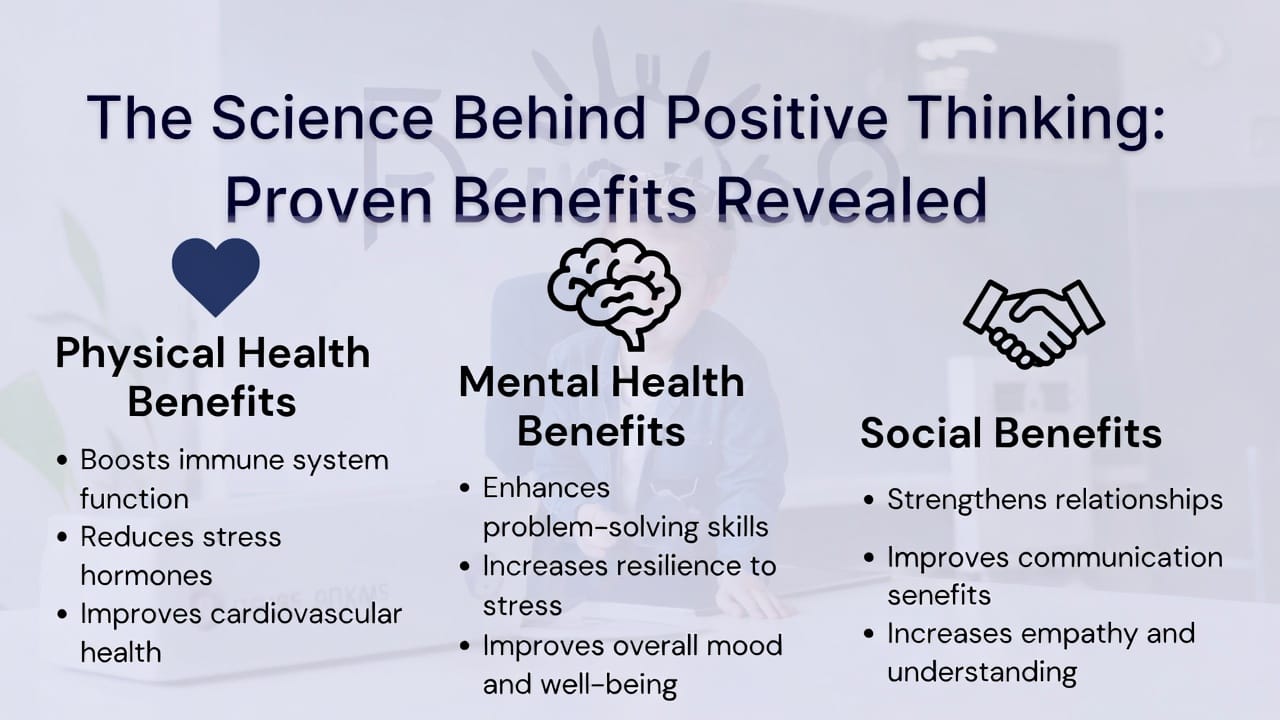
The Science Behind Positive Thinking
Introduction
In a world filled with challenges, stress, and uncertainty, the idea of “positive thinking” often gets dismissed as fluffy self-help advice or mere wishful thinking. But what if there’s solid science backing the power of an optimistic mindset? Research from neuroscience, psychology, and even medicine reveals that cultivating positive thoughts isn’t just feel-good rhetoric—it’s a tangible tool for improving health, resilience, and success.
This article dives into the science behind positive thinking, exploring brain mechanisms, key studies, proven benefits, and practical ways to harness it. Backed by decades of empirical evidence, positive thinking emerges not as blind optimism but as a trainable skill with measurable impacts on your life.
Defining Positive Thinking: More Than Just “Think Happy Thoughts”
Positive thinking isn’t about ignoring reality or forcing a smile through tough times. Psychologists define it as a mental attitude that focuses on possibilities, solutions, and growth rather than dwelling on negatives. It’s rooted in cognitive behavioral theory, where thoughts influence emotions and behaviors.
Key components include:
- Optimism: Expecting good outcomes while preparing for challenges.
- Gratitude: Actively appreciating what’s good in life.
- Resilience: Bouncing back from setbacks with a growth mindset.
Harvard researcher Shawn Achor distinguishes this from “toxic positivity,” emphasizing realistic positivity grounded in evidence. Studies show that people who practice it experience lower cortisol (stress hormone) levels and higher dopamine (reward chemical) release, setting the stage for the neurological science.
The Neuroscience: How Positivity Rewires Your Brain
Modern brain imaging like fMRI has unlocked how positive thinking physically changes the brain—a phenomenon called neuroplasticity.
The Role of Key Brain Regions
- Prefrontal Cortex (PFC): The brain’s executive center for decision-making and emotional regulation. Positive thinkers show thicker PFC gray matter, linked to better focus and impulse control. A 2018 study in Psychological Science found that optimistic individuals had more PFC activity during stress tasks, reducing anxiety.
- Amygdala: The fear center. Chronic negativity enlarges it, heightening reactivity. Positive interventions, like daily gratitude journaling, shrink amygdala size, as shown in a UCLA study where participants scanned after eight weeks saw a 23% volume reduction.
- Hippocampus: Memory and learning hub. Positivity boosts neurogenesis (new neuron growth) here via BDNF protein, combating depression. Research from Yale University links optimism to larger hippocampal volumes, improving memory recall of positive events.
Neuroplasticity in Action
Neuroplasticity means the brain adapts based on repeated thoughts. “Neurons that fire together wire together,” as psychiatrist Daniel Siegel puts it. A landmark 2007 study by Richard Davidson at the University of Wisconsin trained participants in compassion meditation (a positivity booster). After just two weeks, fMRI showed increased gamma waves—indicating heightened focus and positivity—in the left PFC, persisting months later.
Example: Tibetan monks practicing loving-kindness meditation exhibit the highest recorded left PFC activity, correlating with profound happiness levels. This proves positivity isn’t innate; it’s cultivable.
Psychological Studies: Evidence That Stacks Up
Dozens of longitudinal studies confirm positive thinking’s effects.
Optimism and Longevity
The Nun Study (initiated in 1986) analyzed 678 nuns’ autobiographies written in their 20s. Those expressing positive emotions lived up to 10 years longer, even controlling for age and health. Optimism predicted 15-30% lower mortality risk.
A meta-analysis in PNAS (2019) reviewed 83,000+ participants: Pessimists died 14% sooner than optimists, independent of socioeconomic factors.
Health Outcomes
- Cardiovascular Health: The Women’s Health Initiative tracked 100,000 women; optimists had 30% lower heart disease risk, per a 2015 Circulation study.
- Immune Function: Positive affect increases antibody production. Carnegie Mellon research showed happy thinkers fought flu better post-vaccination.
The Placebo Effect and Beyond
Positive expectations trigger real physiological changes. In pain studies, believing treatment works reduces perceived pain via opioid release in the brain, mimicking actual drugs (per New England Journal of Medicine).
Barbara Fredrickson’s Broaden-and-Build Theory posits positivity expands awareness, fostering creativity and problem-solving. Her lab experiments: After watching uplifting films, participants solved puzzles 20% faster than neutral-film viewers.
Tangible Benefits: From Body to Career
The science translates to everyday gains.
Physical Health
Positive thinking lowers inflammation markers like C-reactive protein (25% reduction in optimists, per Ohio State study). It aids recovery—breast cancer patients with positive outlooks healed 40% faster post-surgery (Cancer journal, 2005).
Mental Health and Resilience
It buffers depression: A Dutch study of 1,000+ adults found optimists 50% less likely to develop major depressive disorder over time. During COVID-19, optimists reported 20% less anxiety (Journal of Positive Psychology, 2021).
Relationships and Productivity
Positivity spreads via emotional contagion. Shellenbacker’s research: Positive leaders boost team performance by 31%. In marriages, optimistic spouses have 25% higher satisfaction rates (Journal of Family Psychology).
List of workplace benefits:
- Increased creativity (UCLA study: 50% more ideas from positive moods).
- Better decision-making (reduces cognitive biases).
- Higher earnings: Optimists earn 10-15% more over careers (University of Chicago).
Real-Life Examples and Case Studies
Consider Michael Phelps, the Olympian with 28 medals. Despite depression, he used visualization—picturing wins—which neuroscience confirms activates the same motor pathways as real practice. Phelps credits it for clutch performances.
Corporate case: General Electric’s “Imagination Breakthrough” initiative trained 100,000 employees in positive inquiry, yielding $2 billion in innovations.
Everyday hero: Viktor Frankl, Holocaust survivor and psychiatrist, theorized in Man’s Search for Meaning that attitude shapes suffering. His logotherapy, emphasizing meaning-seeking (a positive practice), influenced modern CBT.
Anecdotal but science-backed: Apps like Headspace track users; gratitude modules increase happiness scores by 25% in four weeks, mirroring lab results.
Cultivating Positive Thinking: Science-Backed Strategies
You can train your brain starting today. Here’s how, with evidence:
- Gratitude Journaling: Write three things daily. UC Davis meta-analysis: Boosts happiness 25%, reduces depression 35%.
- Cognitive Reframing: Turn “failure” into “lesson.” Beck’s CBT trials show 70% symptom reduction.
- Mindfulness Meditation: 10 minutes/day grows PFC (Harvard study). Apps like Calm replicate Davidson’s results.
- Social Connections: Positive interactions release oxytocin. Weekly friend meetups cut stress 20% (Emotion journal).
- Visualization: Athletes’ secret—daily mental rehearsal enhances performance 13% (meta-analysis in Journal of Sport & Exercise Psychology).
Start small: Track mood shifts after one week. Consistency builds the neural pathways.
Conclusion
The science is clear: Positive thinking isn’t pseudoscience—it’s a proven lever for brain health, longevity, and thriving. From rewiring neural circuits to stacking real-world wins, optimism delivers. Embrace it not as naivety, but as empowered realism. Your brain is plastic; shape it positively today.
Infinite Power Consulting – Where Potential Meets Possibility